BAY BRIDGE CHAOS: WHEN STUNT CULTURE HIJACKS PUBLIC INFRASTRUCTURE
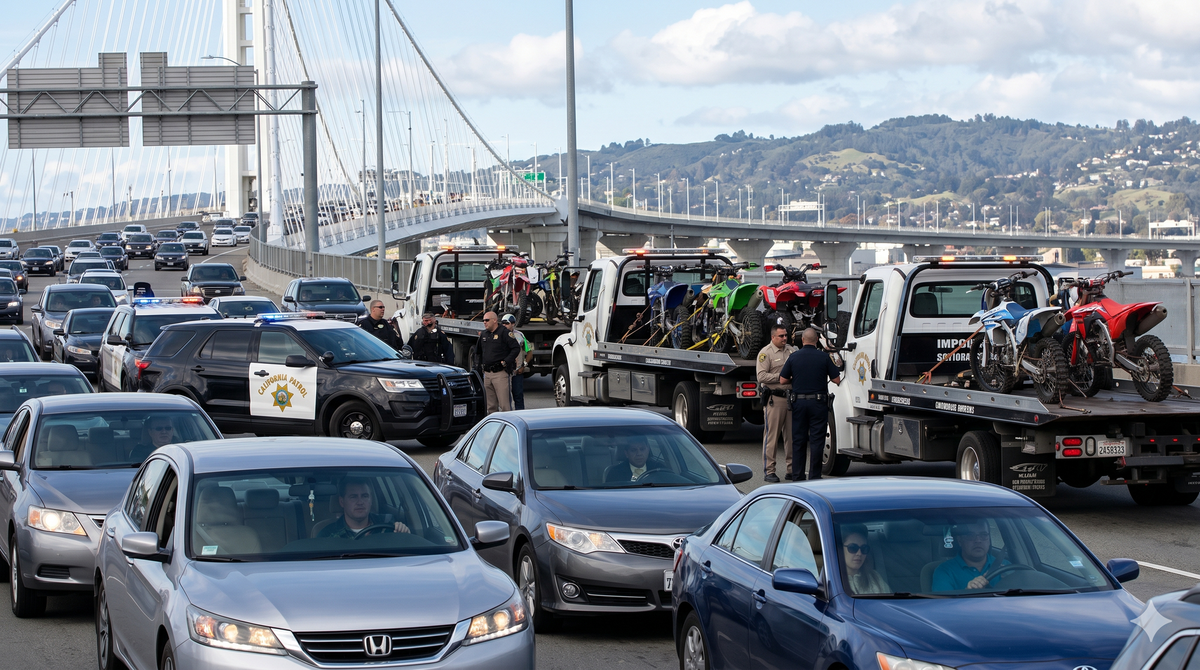
Nine Arrests, 77 Vehicles, and One Bridge Turned Into a Stage
By: Travis Allen
|
May 6, 2026
Overarching Concept: The hijacking of public infrastructure by organized stunt culture and the resulting breakdown of civic order.
Why It Matters: When critical roadways are turned into playgrounds, ordinary commuters pay the price—breeding cynicism and eroding trust in the systems meant to keep us safe.
Picture this: you’re on your way home, maybe tired, maybe late, maybe just trying to make it across the bridge and back to your family. Then the lane slows, the noise rises, and suddenly the highway feels less like a public road and more like somebody else’s arena.
That is the part people keep missing. A stunt takeover is never just about dirt bikes. It is about everyone else being forced to participate in someone else’s adrenaline rush. And once a bridge becomes a stage, the question stops being whether the riders were reckless. The question becomes why our public life keeps getting pushed to the edge before anybody steps in with enough force to matter.
On May 3, 2026, Oakland police and regional partners shut down a planned Bay Bridge dirt bike and ATV takeover after tracking the group for about two months. According to reporting, officers used drones, undercover work, and coordinated enforcement to stop the event, leading to nine arrests and the recovery or impoundment of 77 vehicles.
That is the hard fact pattern. This was not a spontaneous traffic jam or a few kids acting foolish for ten minutes. It was organized. It was deliberate. And it forced ordinary commuters to deal with the consequences of other people turning public infrastructure into a stunt zone.
That is why this story hits a nerve. People can tolerate inconvenience. They can even tolerate a lot of mess. What they cannot tolerate for long is the feeling that no one is really in charge. Once that belief takes hold, every siren, every closure, every delay becomes proof that the system is drifting. That is where frustration starts. Then cynicism follows.
The left-leaning view sees the deeper story. Young riders are not only being reckless; they are chasing status, belonging, and excitement in a culture that rewards risk with attention. That argument is not some soft excuse. It is grounded in real research on peer influence, masculinity norms, thrill-seeking, and group identity. If you want fewer takeovers, you cannot just punish the last one. You have to make the next one less attractive.
The right-leaning view is equally grounded in reality. A bridge is not a playground. Commuters should not have to carry the cost of someone else’s rebellion. And when the state waits too long, people read that delay as permission. They do not see compassion. They see surrender.
The honest steel-man position is that both sides are defending something real. One side is defending the human causes underneath the behavior. The other is defending the civic duty to keep roads, bridges, and transit systems usable for everybody else. And that is where the fake debate falls apart. We do not have to choose between understanding the kids and protecting the commuters. We can do both. We should do both.
This is where motivated reasoning kicks in. People do not just react to the facts. They react to the part of the story that confirms what they already believe about authority, fairness, and danger. If you lean left, you are likely to see alienation first. You ask, what happened to these kids? Who failed them? Why does the system only show up with handcuffs after it has already ignored them?
If you lean right, you are likely to see a basic moral test. You ask, why should law-abiding people be trapped while a few riders turn a public bridge into their personal content farm? Why is the burden always shoved onto the people who follow the rules?
Both reactions have a moral center. Both think they are protecting the innocent. That is why this debate gets so loud. People are not just arguing policy. They are defending their view of what fairness even means. The practical answer is not glamorous, but it works better than either fantasy. Stop organized takeovers early. Prosecute repeat offenders consistently. Use technology carefully and transparently when the threat is real. And build legal, community-based outlets for young riders so the only way to get attention is not by endangering strangers on a bridge. In other words: make chaos costly, and make better options real.
If you live in a city, this story matters to you even if you never set foot on the Bay Bridge. Because the same question follows every community: how much chaos do we tolerate before we stop calling it culture and start calling it a threat?
Commuters pay first. Taxpayers pay next. Then the police, transit workers, and emergency responders are asked to clean up the mess while everyone debates blame on social media.
That is why the solution has to be both firm and smart. Enforce the line. Protect the bridge. Prosecute the people who turn public roads into a danger zone. But also build better pathways for young people who are chasing speed, belonging, and attention in all the wrong places. A community gets stronger when ordinary people can trust that the basics still work. Roads. Bridges. Order. Safety. If those start feeling optional, everything else gets harder to hold together.
“This wasn’t just a bunch of bikes on a bridge. It was what happens when rebellion becomes performance and ordinary people are forced to absorb the cost.”
“A bridge is not a playground. Once public infrastructure becomes a stage, the city has already lost a little of its sense of order.”
“We do not have to choose between understanding the kids and protecting the commuters. We can do both. We should do both.”
At what point does “youth culture” become deliberate endangerment of the public?
If a bridge needs drones to stay open, what does that say about deterrence in our cities?
Can a city rebuild trust if the only time it shows up is after chaos becomes embarrassing?
Share your thoughts on how cities should balance public safety, infrastructure security, and youth outreach.
1. What is the best response to organized street takeovers on public infrastructure?
2. How concerned are you that drone policing could become normal if public disorder rises? (1 = Low, 10 = High)
3. Should cities create more legal riding spaces to reduce the appeal of street takeovers?
Travis Allen is a researcher and storyteller focused on translating complex policy into clear, civic-minded narratives. He covers government, ethics, and the human stories behind the headlines—always looking for pragmatic, bipartisan fixes that protect people. Join the conversation at The Travis Allen Show, where facts meet common-sense solutions.

Contact Me: I truly believe that delivering news without the jargon, with empathy and truth, is how we build connection and a loyal following. If this discussion resonated with you, or if you have your own insights to share, I invite you to send me a direct message by visiting me on Facebook or sending an email to TheTravisAllenShow@gmail.com.
Category: Current Events / Psychology | Sub-Category: Public Safety, Urban Disorder, Policing


